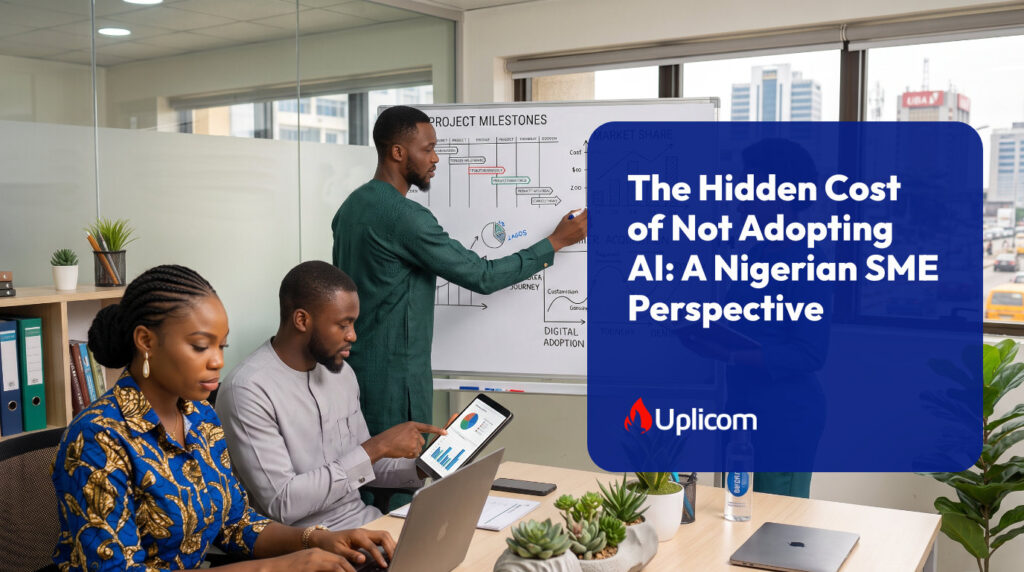

Artificial intelligence is no longer reserved for large corporations and technology companies. Nigerian small and medium-sized enterprises can already use AI to automate routine tasks, improve customer service, create content, analyse information and make better decisions — and most of the tools are already sitting inside software those businesses pay for.
But there is a problem. With the constant stream of AI tools, trends and “10 AI tools you need” lists online, many business owners are starting in the wrong place. They are asking “Which AI tool should my business use?” when the better question is: “Which part of my business is wasting the most time, money or effort — and can AI help fix it?”
That is where Nigerian SMEs should actually start. This guide walks through how to find that first workflow, which tools are worth paying for, what they realistically cost in naira, and how to stay on the right side of the Nigeria Data Protection Act while you do it.
Why AI matters for Nigerian SMEs
For most Nigerian SMEs, the constraint is not ambition or ideas. It is limited manpower, rising operating costs, repetitive administrative work, inconsistent customer service and constant pressure to do more with fewer resources. A five-person team is often carrying the workload of fifteen.
AI helps with a specific slice of that. A business owner can use it to draft proposals, summarise meetings, answer frequently asked customer questions, generate social media content, analyse spreadsheets and automate repetitive workflows. The value is not that AI “does things” — it is that AI gives a small business back productive hours. For a team of six, recovering five hours a week per person is roughly three-quarters of an extra staff member, at a fraction of the cost of hiring one. Those hours go into sales, customer relationships, product development and planning.
The one question to ask before you buy anything
The best starting point is not an expensive AI platform. It is a repetitive business process.
Look at what your team does over and over, every day or every week: answering the same customer questions, writing social captions, preparing reports, sending follow-ups, sorting customer information, creating invoices and quotations, summarising documents, entering data into spreadsheets, preparing meeting notes, writing proposals.
If a task is repetitive, rules-based, time-consuming and does not require constant human judgement, it is a strong candidate for AI assistance or automation.
A 30-minute workflow audit
Ask each team member to list every task they repeated more than three times last week. For each one, note roughly how long it took and whether the output follows a predictable format. Anything that is high-frequency and format-predictable goes to the top of your list. That list — not a vendor’s feature page — is what should determine your first AI purchase.
The five best places for a Nigerian SME to start
1. Customer service
Customer service is the easiest place for most SMEs to see a return. Nigerian businesses field enquiries across WhatsApp, Instagram, email, the website and phone, and the same handful of questions dominates: What is your price? Do you deliver to Lagos? How long will delivery take? What are your opening hours? Do you have this in stock?
Rather than having staff answer every basic question manually, an AI-assisted support layer can handle the repeat enquiries and escalate anything complex to a human. Tools like Microsoft Copilot Studio let you build a support agent trained on your own product list, pricing and policies, and connect it to your website or messaging channels without writing code.
The goal is not to replace your customer service team. It is to let them spend their attention on the customers who actually need a person.
2. Content and marketing
Most SMEs need to market online, but producing consistent content is hard when the owner is also running sales, operations and finance.
AI can carry the first draft of social captions, blog outlines, email campaigns, product descriptions, video scripts, ad copy and content calendars. Adobe Express with Firefly handles the visual side — generating and resizing marketing graphics for Instagram, LinkedIn and print without a designer for every small asset. Microsoft 365 Copilot and Gemini in Google Workspace both draft written content directly inside the tools your team already uses.
The caution matters as much as the capability: never publish AI-generated content unreviewed. AI produces generic phrasing and occasionally invents facts. Your brand still needs a human voice, local context and fact-checking. Treat AI as a content assistant, not a marketing department.
3. Administrative work and automation
Admin quietly consumes an enormous share of a small business’s week — copying data between spreadsheets, filing documents, writing routine emails, compiling recurring reports.
This is where automation, rather than chat, does the heavy lifting. A typical first build: a customer submits a Microsoft Form, Power Automate writes the entry into a SharePoint list, notifies the right staff member in Teams, and drafts a follow-up email for approval. Google Workspace customers can achieve similar results with AppSheet and Apps Script. Nobody coordinates the steps manually, and nothing falls through the cracks.
Automations like these are usually cheaper and more reliable than a chatbot, and they are often already included in the licences you hold.
4. Business data and reporting
You do not need a data science team to get value from your own numbers. Most SMEs already hold useful data in spreadsheets, accounting software, sales records and inventory systems.
Copilot in Excel and Gemini in Google Sheets can surface patterns in that data conversationally — which products are selling fastest, which months generate the most revenue, where expenses are climbing, which marketing channels produce the most leads. Google’s NotebookLM is useful when the source material is documents rather than rows: upload a year of reports and interrogate them directly.
AI should support the decision, not make it. The judgement stays with the business owner; what changes is how quickly they get to a well-informed one.
5. Internal documents and communication
Starting every document from a blank page is expensive. AI can produce a workable first draft of proposals, reports, meeting summaries, standard operating procedures, internal memos, job descriptions, training materials and customer emails, which your team then edits.
Meeting summarisation is often the fastest win here — Copilot in Teams and Gemini in Google Meet both transcribe, summarise and extract action items automatically, which removes an entire category of after-meeting admin.
Which AI tools should a Nigerian SME actually use?
The right tools depend on the software your business already runs on. In practice, most Nigerian SMEs fall into one of three ecosystems, and the cheapest good decision is usually to activate AI inside the one you are already paying for.
If you run on Microsoft 365
Microsoft 365 Copilot embeds AI into Word, Excel, Outlook, PowerPoint and Teams, working across your own emails, files and meetings. Copilot Chat provides a lower-cost entry point for general drafting and research. Copilot Studio builds custom agents and support bots, and Power Automate handles workflow automation. If your business already runs on Microsoft 365 Business Standard or Business Premium, much of the automation capability is available to you today.
If you run on Google Workspace
Gemini is built into Gmail, Docs, Sheets, Slides and Meet, with AI features now included in most Business and Enterprise Workspace plans rather than sold separately. NotebookLM handles document research and summarisation, and AppSheet covers no-code workflow apps.
If content and design are the priority
Adobe Express with Firefly generates commercially-safe marketing visuals, and Acrobat’s AI Assistant summarises and answers questions across long PDFs — useful for contracts, tenders and reports.
Choosing between them
Do not run two ecosystems in parallel unless you have a strong reason. The overlap wastes money and splits your data across platforms, which makes both governance and automation harder later. The principle throughout: the tool should follow the business problem, not the other way around.
Not sure which licences you already have AI access to? We run a free 30-minute licence review for Nigerian SMEs. [Book a review →]
What does AI actually cost in Nigeria?
Cost is where most Nigerian SME AI projects stall, and not for the reason most people assume.
The real barrier is forex, not the sticker price
Most AI subscriptions are priced in US dollars. For Nigerian businesses that means naira volatility making next quarter’s software budget unpredictable, dollar card limits that block or fail recurring international payments, and difficulty obtaining a proper invoice for tax and audit purposes. A business can be perfectly willing to pay and still be unable to.
This is solvable. Buying through a local licensed partner means being invoiced in naira, paying through local channels, and receiving documentation your accountant can actually file.
AI tool costs for Nigerian SMEs
Indicative pricing as at 8 August 2026. Converted at ₦1,400/$1.
| Tool | Typical plan for an SME | Indicative cost per user/month |
| Microsoft 365 Copilot Chat | Included with any eligible Microsoft 365 business plan | Included — ₦0 |
| Microsoft 365 Business Standard | Core productivity suite, no Copilot | ~₦19,600 ($14) |
| Microsoft 365 Business Premium | Adds device management and advanced security | ~₦30,800 ($22) |
| Microsoft 365 Copilot (SMB add-on) | Add-on for businesses under 300 users, annual commitment | ~₦25,200 ($18, promotional) |
| Business Standard + Copilot bundle | Suite and Copilot purchased together | ~₦44,800 ($32) |
| Microsoft Copilot Studio | Custom AI agents — billed per tenant, not per user | ~₦280,000/month ($200 prepaid credit pack) |
| Google Workspace Business Starter | Limited Gemini — Gmail side panel only | ~₦9,800 ($7) |
| Google Workspace Business Standard | Full Gemini across Docs, Sheets, Slides, Gmail, Meet | ~₦19,600 ($14) |
| Google Workspace Business Plus | Adds advanced security and compliance controls | ~₦30,800 ($22) |
| Adobe Express for teams | Branded marketing content with Firefly generative AI | ~₦14,000 ($9.99) |
| Adobe Acrobat Pro for teams | AI Assistant for contracts, tenders and long reports | ~₦33,600 ($23.99) |
| Adobe Creative Cloud Pro for teams | Full creative suite with premium Firefly credits | ~₦112,000 ($79.99) |
Work out the return before you subscribe
The arithmetic is simple. If a tool costs ₦50,000 per month for a team, and it saves that team 40 hours of work a month, you are paying ₦1,250 per hour recovered. Compare that against what an hour of your team’s time costs and against what those hours are redeployed into. If the recovered hours go into sales conversations, the tool likely pays for itself several times over.
But if you pay for a platform nobody opens, the subscription is just another line item. The goal is not to spend money on AI. It is to use AI to create measurable business value.
Data privacy and the NDPA
Nigeria’s Data Protection Act 2023 governs how businesses handle personal data, and it applies to AI tools exactly as it applies to any other system that processes customer information. If your team is pasting customer names, phone numbers, financial details or contract terms into a public AI chatbot, that is a processing activity you are accountable for.
Before adopting a tool, establish what data it collects, how that information is processed and stored, who can access it, whether it is used to train the provider’s models, and where it is hosted. Enterprise tiers of Microsoft 365 Copilot and Gemini for Workspace carry substantially stronger data commitments than free consumer chatbots — including that your business data is not used to train the underlying models — which is one of the strongest arguments for licensing properly rather than letting staff improvise with free accounts.
Give employees written guidelines on what may and may not be entered into AI tools. Sensitive customer records, passwords, financial credentials and confidential contracts should not be pasted into a public chatbot. AI adoption is a data governance exercise, not just a tool selection exercise.
Train your people before blaming the technology
Buying an AI tool does not make a business efficient. Adoption does, and adoption depends on training.
Your team needs to learn how to write effective prompts, verify AI-generated information, recognise where the tool gets things wrong, protect confidential data, and fold the tool into workflows they already follow. Without that, licences go unused and the pilot is written off as a failure of the technology rather than of the rollout. Budget for training in the same breath as licensing. AI literacy is now part of baseline digital skills for an SME team.
The three mistakes that waste the most money
Buying tools before defining a problem. Businesses routinely subscribe to five AI platforms when two would do. Before purchasing, answer: what problem does this solve, how often does it occur, how much time does it consume today, who will use it, and how will we know it worked? If you cannot answer those, you do not need the tool yet.
Attempting a full transformation at once. Rolling AI into every department simultaneously guarantees that nothing is adopted properly. One workflow at a time compounds; five at a time collapses.
Framing it as replacing people. For an SME, the productive question is which tasks AI can absorb so employees can move to higher-value work. Someone who spent three hours on a routine report may now spend thirty minutes reviewing an AI draft — the other two and a half hours go to customers, operations or sales. Businesses that treat AI as headcount reduction generally get neither the savings nor the adoption.
A 90-day AI roadmap for Nigerian SMEs
If your business has never used AI seriously, this sequence keeps spending low and learning high;
Step 1 — Audit your workflows. Run the 30-minute exercise above and identify the repetitive tasks consuming the most time.
Step 2 — Pick one problem. Choose the highest-frequency, most format-predictable task. Resist the urge to fix everything.
Step 3 — Test with what you already own. Check whether your existing Microsoft 365 or Google Workspace licences already include the capability before buying anything new. Very often they do.
Step 4 — Measure. Track hours saved, costs reduced, errors prevented, leads generated or customer response times improved. Set the baseline before you start, or you will have nothing to compare against.
Step 5 — Scale what works. Once a workflow proves out, extend the same approach to the next one on your list.
A realistic first quarter: month one on content and drafting, month two on AI-assisted customer support, month three on automating one administrative process. Slower than the vendor timeline, considerably more likely to stick.
What this looks like across sectors
A fashion brand uses AI to speed up content production and product photography workflows. A professional services firm uses it to organise documents and prepare client reports. An e-commerce business uses it to handle first-line customer support across WhatsApp and Instagram. A financial services SME automates administrative and reconciliation workflows. A media company uses it for research, transcription and content planning.
Different sectors, same principle: start with the problem, not the technology.
Frequently asked questions
Is AI expensive for a small business in Nigeria?
Not necessarily. Many businesses already have AI features included in their existing Microsoft 365 or Google Workspace subscriptions and are simply not using them. Where a paid add-on is needed, the practical question is whether the hours it recovers are worth more than the monthly cost — not whether the subscription is cheap in absolute terms.
Can AI answer my WhatsApp and Instagram customers?
Yes, for routine enquiries. An AI support agent can be trained on your pricing, delivery areas, opening hours and stock, then connected to your messaging channels to handle repeat questions and escalate anything complex to a person. It works best as a first line, not a replacement for your team.
Is it safe to put customer data into AI tools?
It depends entirely on the tool. Free consumer chatbots and licensed business tiers have very different data commitments. Under the Nigeria Data Protection Act 2023 your business remains accountable for how customer data is processed, so use business-licensed tools with clear data terms and give staff written rules about what may be entered.
Which is better for a Nigerian SME — Microsoft Copilot or Google Gemini?
Whichever matches the software your business already runs on. If your email, files and meetings live in Microsoft 365, Copilot has more context to work with; if you run on Google Workspace, Gemini does. Running both usually costs more without adding capability.
How long before we see results from AI?
For a single well-chosen workflow, usually a few weeks — drafting and meeting summarisation produce visible time savings almost immediately. Automation projects take longer to build but deliver more durable value. Full organisational change is a multi-quarter effort, which is why starting with one workflow matters.
Do we need a technical team to use AI?
No. Most of the tools discussed here are designed for non-technical users, and workflow automation is increasingly no-code. What you do need is someone accountable for the rollout — choosing the workflow, training the team and measuring the outcome.
Final thoughts
AI adoption for Nigerian SMEs does not have to begin with expensive software, complex automation or a full digital transformation. Find a task that wastes time. Test whether AI makes it faster, cheaper or better. Measure the result. Then scale.
The businesses that benefit most will not be the ones using the most AI tools. They will be the ones that understand where AI creates value and integrate it deliberately. The future of AI adoption in Nigeria should not be about following the hype — it should be about solving real business problems.
Book a free AI readiness review [Book a review →]