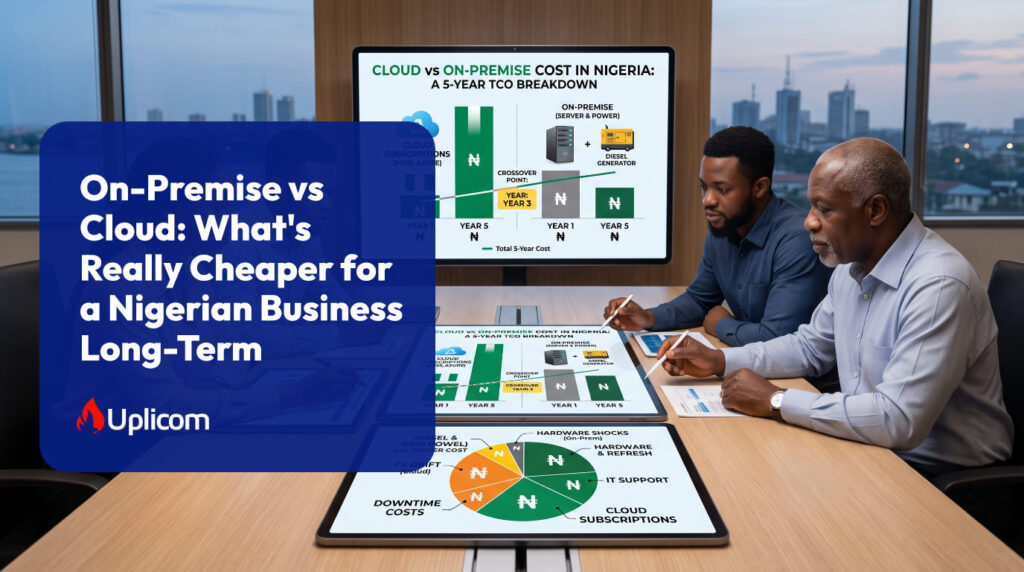
A Nigerian SME buys a server for ₦8 million. Five years later, on a reasonable set of assumptions, that decision has cost the business closer to ₦100 million.
Almost none of that gap is the server. It is electricity, diesel, cooling, licences, the person who maintains it, and the hours the business could not trade because something failed.
This is the cost comparison most businesses never run. They put a hardware quote next to a monthly subscription, notice the hardware is cheaper after 18 months, and stop there. The real question is not which option costs less today. It is which option costs less to own, operate and recover over three to five years — and in Nigeria that answer is shaped by power, connectivity and the exchange rate more than by anything on the vendor’s price list.
What On-Premise Infrastructure Really Includes
On-premise means your business owns and operates the physical equipment running its systems: servers, storage, switches and firewalls, backup appliances, cooling, UPS and power equipment.
The attraction is control. You own it, you know where your data sits, and nobody can change your pricing at renewal.
The cost is that you own everything else too. Every watt it draws, every hour of downtime, every replacement battery, and every hour of someone’s time spent patching it.
What Cloud Actually Changes
Cloud computing means renting computing, storage and software from a provider instead of buying the underlying infrastructure. Instead of ₦8 million for a server, you pay a recurring fee for the capacity you use — an Azure virtual machine, Microsoft 365 seats, Google Workspace licences, Adobe Creative Cloud for a design team.
What changes is not the total amount of money. It is the shape of the spend: large, lumpy capital purchases become smaller, predictable operating costs, and the responsibility for the physical layer moves to the provider.
Cloud is not automatically cheaper. It is differently expensive, and whether that difference works in your favour depends almost entirely on the numbers below.
The Cost Nigerian Businesses Underestimate Most: Power
A server does not just consume electricity. The room it sits in needs cooling, and the cooling runs whether or not the grid is up. When the grid is down, both run on diesel.
Two figures drive everything here. NERC Band A tariffs ran at roughly ₦209.50 to ₦225 per kWh through 2026 depending on the distribution company — Ikeja Electric quoted ₦206.80/kWh. And diesel rose to around ₦1,750 per litre at Dangote’s gantry price effective 1 September 2026, with marketers retailing closer to ₦1,800.
Now apply them to a modest single-rack setup:
- IT load of 1.2 kW (two servers, storage, a switch and a firewall)
- A cooling and UPS overhead multiplier of 1.8, giving a total continuous draw of 2.16 kW
- 18 hours of grid supply a day at ₦215/kWh
- 6 hours a day on a generator burning 0.35 litres per kWh delivered at ₦1,750/litre
That is roughly ₦3.05 million of grid electricity and ₦2.90 million of diesel in year one. Just under ₦6 million, before you have paid a single person to look after the equipment, and before inflation. Applying 15% annual naira cost inflation, power and fuel alone come to about ₦40 million over five years — five times the price of the server.
This is the number that decides most Nigerian infrastructure arguments, and it is the number almost nobody puts in the business case.
The Real Five-Year Cost of a ₦8 Million Server
Here is the full model, on the assumptions listed beneath it.
| Cost line | Five-year total |
| Server, storage and network hardware (including a partial year-5 refresh) | ₦12,800,000 |
| UPS and battery replacement | ₦1,800,000 |
| Server room air conditioning | ₦900,000 |
| Backup hardware and offsite setup | ₦1,200,000 |
| Software licences — upfront | ₦2,500,000 |
| Grid electricity (Band A) | ₦20,572,000 |
| Diesel for generator hours | ₦19,535,000 |
| Generator servicing (IT share) | ₦1,348,000 |
| AC and UPS servicing | ₦1,011,000 |
| Software licences — annual renewals | ₦2,697,000 |
| IT support and maintenance | ₦8,091,000 |
| Backup running costs | ₦2,023,000 |
| Physical security share | ₦1,011,000 |
| Cost of unplanned downtime | ₦24,273,000 |
| Total five-year cost of ownership | ₦99,761,000 |
Assumptions: 15% annual naira cost inflation; ₦215/kWh Band A tariff; ₦1,750/litre diesel; 18 hours grid and 6 hours generator per day; 2.16 kW total continuous load; 24 hours of unplanned downtime a year valued at ₦150,000 per hour; 60% of original hardware cost spent on refresh in year five.
Change the assumptions and the total moves — that is the point. If your downtime costs less, strip ₦24 million out. If you are on a Band C feeder running the generator twelve hours a day, add considerably more. What does not change is the ratio: the sticker price is roughly 8% of the true cost.
Hardware Does Not Last Five Years Either
Servers reach end of support, storage fills, and warranties expire. At some point you are buying new hardware, migrating applications and replacing switches — and holding spare components in case something fails first.
Cloud moves that refresh cycle onto the provider. It does not make it free; you pay for it inside the subscription. But it removes the year-four conversation where the business has to find capital it did not budget for.
Somebody Still Has to Maintain It
An on-premise environment needs patching, monitoring, backup verification, hardware replacement, network configuration and disaster recovery testing. Whether that is a salaried engineer, a share of one, or a support contract, it is a real annual cost — ₦8 million over five years in the model above.
Cloud reduces the infrastructure half of this, but not the rest. Someone still manages identities, licences, conditional access, data loss prevention and security policy in Microsoft 365 or Google Workspace. Migrating to cloud changes what your IT people do. It does not remove the need for them.
So the honest comparison is not server price vs monthly subscription. It is total cost of operating the server vs total cost of operating the cloud environment.
The Costs Cloud Adds That People Forget
Cloud has its own line items, and quotes routinely miss them:
- Subscriptions and per-seat licences
- Storage, compute and egress charges that scale with usage
- Backup, which is usually a separate service and not included by default
- Security tooling and premium support tiers
- Migration: assessment, data transfer, cutover, parallel running and training
- A second internet connection, which becomes mandatory rather than optional
- Additional software licences that were previously perpetual
Consumption-based pricing in particular catches businesses out. Store more data or run more compute and the bill rises, so a cloud environment that is never reviewed tends to get more expensive every year. This is why moving everything to cloud does not automatically reduce an IT budget.
How Exchange Rate Changes Affect Your Cloud Bill
Most major cloud services are priced in US dollars. With the naira around ₦1,345 to the dollar as of 1 September 2026, a $1,000 monthly subscription is roughly ₦16.1 million a year. At ₦1,600 it is ₦19.2 million for exactly the same service.
That is a genuine budgeting problem for a business earning in naira, and it deserves a line in the risk register.
But on-premise is not sheltered from it. Servers, switches, licences, replacement drives and UPS batteries are all imported or dollar-linked. The difference is timing: on-premise concentrates the FX exposure into occasional large purchases, cloud spreads it across every month. One creates budget shocks, the other creates budget drift.
A practical mitigation is to buy reserved instances or annual commitments when the rate is favourable, rather than paying month to month at whatever the rate happens to be.
Internet Connectivity: Cloud’s Real Single Point of Failure in Nigeria
Your cloud environment is only as available as your internet connection. One fibre cut and the office cannot reach anything.
Any Nigerian business moving critical workloads to cloud should budget for connectivity resilience from the start:
- A second ISP on a genuinely different route, not a reseller of the first
- A different underlying technology — fibre plus fixed wireless or LTE
- Automatic failover configured and tested, not a manual switch nobody remembers
- Offline access for the documents people need during an outage
This is a real cost, not a footnote, which is why it appears as a line item in the calculator.
Is Cloud More Secure Than On-Premise?
Keeping servers in your own building does not make data safer. It makes you responsible for making it safe.
On-premise security depends entirely on how well your organisation handles physical access, patching, firewall rules, backup testing, monitoring and incident response. Most SME server rooms fail on at least three of those.
Major cloud providers operate infrastructure security at a scale no Nigerian SME can match. But cloud runs on a shared responsibility model: the provider secures the platform, you secure your data, identities and configuration. Most cloud breaches are misconfiguration and credential compromise, not the provider being hacked.
So the useful question is not “which is more secure?” It is: which one can our organisation realistically secure, patch and monitor, given the people we actually have?
What Nigeria’s National Digital Cloud Policy Changes
On 17 August 2026 the Federal Government released the National Digital Cloud Policy, superseding the 2019 framework and sitting alongside the Nigeria Data Protection Act 2023.
Two provisions matter directly to this decision.
First, the policy introduces a four-tier sovereign data classification, and confines residency requirements to specific categories rather than imposing blanket localisation. Level 4 data must be hosted exclusively on infrastructure physically located in Nigeria and under sovereign control, while Level 1 data carries no mandatory residency restriction. So “we can’t use cloud, our data has to stay in Nigeria” is now a question with a precise answer rather than a blanket assumption — and for most commercial data, the answer is that you have options.
Second, the policy mandates a cloud-first approach for federal ministries, departments and agencies, with public cloud procurement consolidated under Galaxy Backbone. If you sell to or work with government, the direction of travel is set.
Before you design any infrastructure, classify your data against those tiers. It will tell you what can move, what must stay, and where a hybrid boundary should sit.
When Cloud Wins and When On-Premise Wins
Cloud tends to be the better financial decision when a business:
- Wants to avoid large upfront capital purchases
- Is growing quickly or has unpredictable workloads
- Has limited internal IT capacity
- Supports remote or hybrid staff
- Needs to deploy new systems in days rather than months
- Is already paying heavily for power and cooling
On-premise tends to hold up when a business:
- Already owns suitable, recently purchased hardware
- Has stable, predictable workloads
- Has strong internal IT capability and genuine 24/7 cover
- Runs specialised or legacy systems that are expensive to migrate
- Holds data that falls into the higher sovereignty tiers
- Has reliable power at a cost well below the assumptions above
Why Hybrid Suits Most Nigerian Businesses
For most organisations this is not a binary choice, and treating it as one is what makes the decision hard.
A practical hybrid split looks like this: email, collaboration, file storage, identity and productivity move to Microsoft 365 or Google Workspace, where per-seat pricing is predictable and the power cost disappears entirely. Creative and marketing teams move to Adobe Creative Cloud. Backup and disaster recovery move to cloud, because offsite copies are the single highest-value thing to move first. Meanwhile, line-of-business applications that are expensive to migrate, and any data in the higher sovereignty tiers, stay on infrastructure you control until there is a reason to move them.
That approach lets you take the power and refresh costs off the books for the workloads where cloud is clearly cheaper, without a disruptive all-at-once migration.
Cloud vs On-Premise: Quick Comparison
| On-premise | Cloud | |
| Cost shape | Large capital purchases, lower recurring | No capital outlay, higher recurring |
| Power and cooling | Yours, and significant | The provider’s |
| Hardware refresh | Every 4–5 years, from capital | Included in the subscription |
| FX exposure | Concentrated in purchases | Spread across every month |
| Scaling up | Weeks, and a purchase order | Minutes |
| Scaling down | Not really possible | Immediate |
| Depends on | Power and cooling | Internet connectivity |
| Security burden | Entirely yours | Shared with the provider |
| Data residency | Full control | Depends on region and tier |
| Best for | Stable workloads, strong IT teams, sovereign data | Growth, remote work, limited IT capacity |
Frequently Asked Questions
Is cloud cheaper than on-premise in Nigeria?
Not automatically. Cloud is usually cheaper for email, collaboration and productivity workloads, where power and refresh costs vanish entirely. It can be more expensive for heavy, stable compute that runs continuously. The determining factors are your electricity band, generator hours and how predictable your workload is.
How much does it cost to run a server in Nigeria per year?
On the assumptions in this article — 2.16 kW continuous load, 18 hours of Band A grid supply and 6 hours of generator running per day — power and diesel alone come to roughly ₦6 million in year one. Add maintenance, licences and support and a single-rack environment realistically costs ₦10–12 million a year to operate.
What is total cost of ownership for IT infrastructure?
TCO is every cost of owning and operating a system across its useful life, not just its purchase price. For on-premise that means hardware, power, cooling, fuel, licences, support, backup, security, refresh and downtime. For cloud it means subscriptions, migration, connectivity, support, downtime and currency movement.
How does the exchange rate affect cloud costs in Nigeria?
Most cloud services are priced in US dollars, so naira depreciation raises your bill even when your usage is flat. At ₦1,345 to the dollar, a $1,000 monthly subscription costs about ₦16.1 million a year; at ₦1,600 it costs ₦19.2 million. Annual commitments and reserved instances reduce this exposure.
Does Nigerian law require my data to be hosted in Nigeria?
Not universally. The National Digital Cloud Policy of August 2026 uses a four-tier classification and applies residency requirements only to defined categories rather than imposing blanket localisation — Level 4 data must sit on Nigerian infrastructure under sovereign control, while Level 1 has no residency restriction. Classify your data before assuming it cannot move.
What happens to cloud systems if my internet goes down?
Access to cloud-hosted systems is interrupted until connectivity is restored. This is why a second ISP on a different route, with tested automatic failover, should be part of any cloud budget rather than an afterthought. Offline file sync also keeps essential documents reachable during an outage.
Is on-premise more secure than cloud?
No. On-premise security depends entirely on how well you patch, monitor, back up and control physical access. Major providers operate security at a scale most organisations cannot match, but cloud uses a shared responsibility model — the provider secures the platform, you secure identities, configuration and data.
How much does cloud migration cost?
Migration is a real project cost covering assessment, data transfer, cutover, a period of parallel running and user training. Budget for it explicitly rather than assuming the first subscription invoice is the whole cost. Complexity, data volume and how many legacy dependencies you carry are the main variables.
Should I move everything to the cloud at once?
Rarely. Most Nigerian businesses get the best result by moving email, collaboration, identity and backup first, where the savings are clearest and the risk lowest, then reassessing line-of-business applications separately. A staged hybrid approach spreads both the cost and the disruption.
What should I ask before approving an infrastructure investment?
Ask what the option costs over five years rather than today; what you currently spend on power and cooling; what happens when the existing hardware reaches end of life; how exchange rate movement affects the bill; what happens if the primary internet link fails; what migration costs; what data cannot move; and what an hour of downtime costs the business.
Work Out Your Own Numbers
Every figure in this article is a modelling assumption, and yours will differ. What will not differ is the direction: once you count power, fuel, refresh and downtime, the cheapest option at the point of purchase is very rarely the cheapest option over five years.
Book a 30 minutes session to assess your current environment and identify the right approach for your organization.