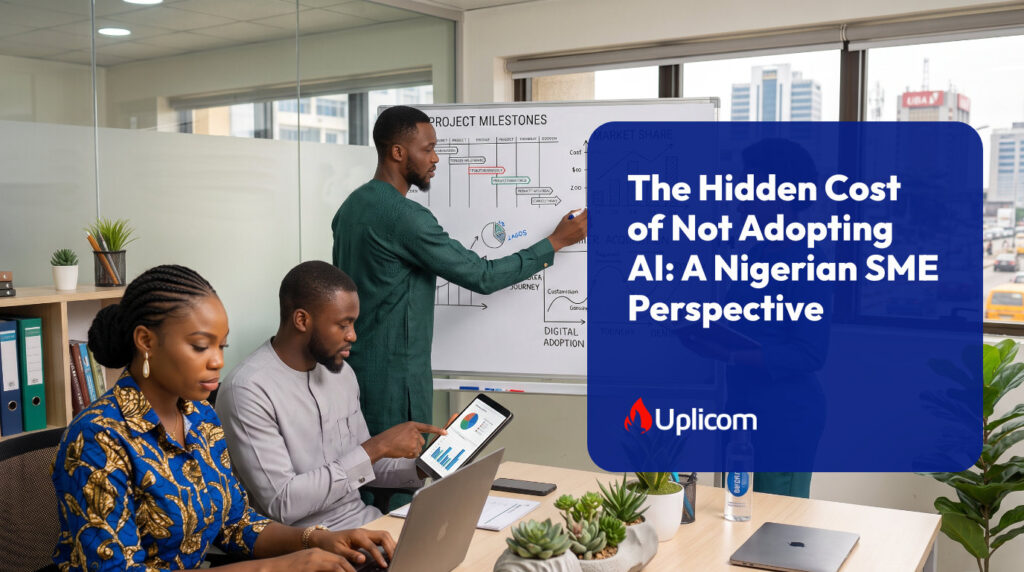
For many Nigerian small and medium-sized enterprises, artificial intelligence still feels like something reserved for technology companies and multinationals.
That perception is expensive.
AI has become an ordinary business tool. It drafts documents, summarises meetings, answers routine customer questions, cleans up spreadsheets and produces first-draft marketing content — work that Nigerian SMEs currently pay skilled employees to do by hand.
The cost of ignoring it does not appear on any invoice. It shows up as hours absorbed, quotations sent late, and enquiries answered a day after a competitor answered them.
For Nigerian SMEs the question has shifted from “Can we afford AI?” to “Can we afford to ignore it?”
The short version
- Two hours a day on routine admin costs roughly 460 hours per employee per year — close to three months of their paid working year.
- The competitive risk is not that AI replaces your business. It is that a competitor with the same headcount starts producing more than you.
- Most SMEs already own part of the answer. AI features are now bundled into Microsoft 365 and Google Workspace plans many businesses already pay for.
- The real risk to manage is data. Staff pasting customer records into free consumer AI tools creates exposure under the Nigeria Data Protection Act 2023.
- Start with one process, measure the hours saved, then expand. Organisation-wide rollouts fail more often than they succeed.
The Cost of Doing Everything Manually
The largest hidden cost of avoiding AI is employee time spent on repetitive work.
In a typical Nigerian SME, staff spend hours every week on:
- Writing routine emails and following up with customers
- Preparing reports, proposals and presentations
- Answering the same customer questions repeatedly
- Entering, cleaning and organising data
- Creating social media and marketing content
- Summarising documents and meetings
- Searching for information across files and inboxes
None of this requires the full attention of a skilled employee. Businesses pay for it anyway.
AI handles the first draft of most of these tasks. The employee reviews, corrects and approves — which is faster than starting from nothing, and which is where their judgement was always worth paying for.
What Ten Hours a Week Actually Costs
The argument becomes concrete once you do the arithmetic.
Take one employee spending two hours a day on routine administrative work. That is 10 hours a week. Across roughly 46 working weeks, it comes to 460 hours a year — the equivalent of eleven and a half full working weeks, or close to three months of that person’s paid year.
Slow Decisions Cost Money
In business, speed compounds; a company that prepares a quotation, answers an enquiry or reviews a supplier contract in minutes wins work that a company needing two days does not. The proposal that arrives first is frequently the proposal that gets read.
AI shortens the gathering-and-processing stage that sits in front of every decision. It summarises a long document, extracts the numbers from a spreadsheet, compares two contracts, drafts a preliminary analysis of customer feedback.
It does not make the decision and it removes the three hours of preparation that used to precede the decision.
The goal is not to let AI run the business. It is to help people run the business faster.
The Competitor Risk Is Real
Picture two Nigerian companies selling similar products with equally capable staff.
Company A writes every marketing post from scratch, analyses sales data manually and answers each routine enquiry by hand. Company B drafts with AI, summarises with AI and handles first-line enquiries with an assisted workflow.
Both have ten employees. Company B ships more — more proposals, more campaigns, faster responses — without hiring.
Over a year, that difference reaches pricing, service quality, marketing frequency and market share. The gap does not announce itself. It appears in the deals you never hear about.
Customer Expectations Have Already Changed
Customers expect fast responses, and Nigerian businesses run a great deal of their customer contact through WhatsApp, Instagram and email.
A business that consistently takes hours to reply loses customers to one that replies in minutes.
AI helps by classifying incoming enquiries, drafting responses to common questions, answering FAQs directly and routing anything complex to a person. Copilot Studio and the agent tooling in Google Workspace both support this without custom development.
The point is not to make service robotic. It is to stop paying experienced staff to answer the same question forty times a week, so they can handle the enquiries that genuinely need a human.
Productivity Is the Answer to a Hard Operating Environment
Nigerian businesses already absorb salaries, diesel and power costs, connectivity, logistics, rent, tax and inflation.
When input costs rise faster than prices, the only durable response is producing more with the same team.
AI functions as a productivity layer over the staff you already employ. The advantage comes from augmenting people, not from cutting them — and in a market where experienced staff are hard to recruit and harder to retain, that distinction matters commercially as well as ethically.
Standing Still Is Also an Investment Decision
Owners hesitate for a legitimate reason: “What if we pay for a tool nobody uses?” It happens, and it is a fair concern.
The second question gets asked far less often: what does it cost if competitors become significantly more productive while we stay manual?
That bill arrives as:
- Slower service delivery and longer response times
- Higher cost per unit of output
- Customers lost to faster competitors
- Marketing that goes out less often and lands with less force
- Difficulty scaling without proportional hiring
Doing nothing is not the neutral option. It is a decision with its own price.
Where to Start: Use Cases by Department
Most SMEs do not need to buy anything exotic. The tools are inside platforms they already run.
| Function | Use case | Tools to look at |
| Marketing | Campaign planning, social drafts, ad copy, image and asset production | Microsoft 365 Copilot; Adobe Firefly; Adobe Express |
| Customer service | FAQ handling, enquiry classification, response templates, first-line agents | Copilot Studio; Gemini in Google Workspace |
| Administration | Meeting recaps, email drafting, document preparation, internal reports | Copilot in Teams and Outlook; Gemini in Gmail and Docs; NotebookLM |
| Sales | Proposal drafts, lead research, follow-up sequences, customer segmentation | Microsoft 365 Copilot; Copilot Chat |
| Finance | Spreadsheet formulas, data cleanup, variance summaries — with human review | Copilot in Excel; Gemini in Sheets |
| HR | Job descriptions, interview questions, onboarding and training material | Microsoft 365 Copilot; Gemini in Google Workspace |
| Documents | Summarising contracts, extracting terms, querying long PDFs | Acrobat AI Assistant |
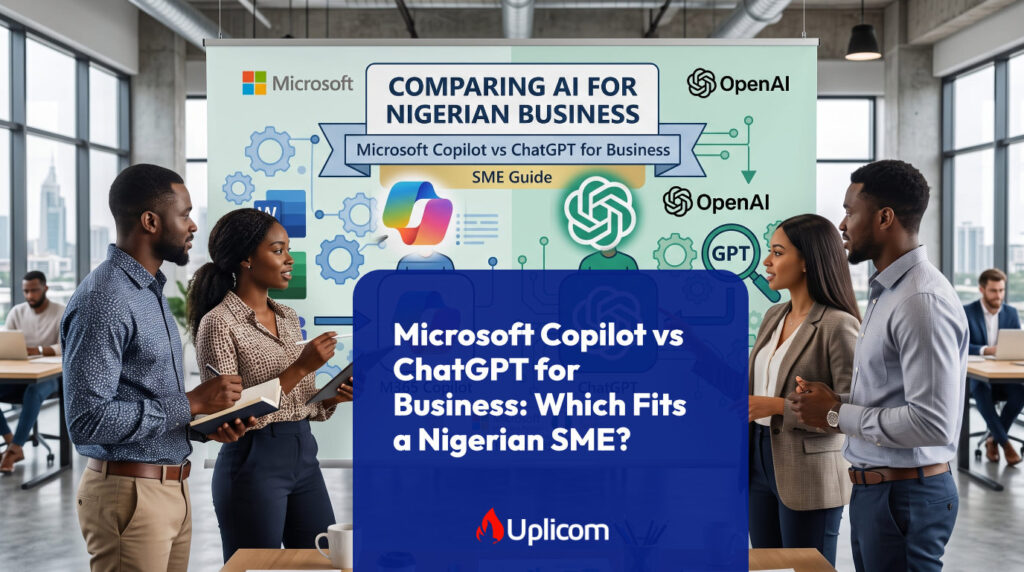
One licensing point worth understanding before you spend anything: Microsoft distinguishes between Copilot Chat, included with many Microsoft 365 business plans, and Microsoft 365 Copilot, a paid per-user add-on that works inside Word, Excel, Outlook and Teams on your own company data. Google has similarly folded Gemini capabilities into its Workspace business tiers. Many Nigerian SMEs are already paying for more AI capabilities than they use.
The test for any use case is simple: name the business problem first, then ask whether AI solves part of it. Adopting a tool because it is fashionable produces expensive shelfware.
Adopting AI Responsibly — and What Nigerian Law Requires
Here is the scenario that should concern every SME owner.
An employee, trying to be efficient, pastes a customer list into a free consumer AI tool to draft follow-up messages. Personal data has now left the business, entered a third-party platform under consumer terms, and may be retained or used for model training.
Under the Nigeria Data Protection Act 2023, enforced by the Nigeria Data Protection Commission, your business remains the data controller and remains accountable for that disclosure. Nigeria’s National Artificial Intelligence Strategy explicitly cross-references the NDPA on data governance, and NITDA has been developing a Code of Practice for AI covering transparency, risk assessment and human oversight.
This is where enterprise tooling earns its cost. Business and enterprise tiers of Microsoft and Google AI services carry commercial data protection commitments — your prompts and company data are not used to train their models — which free consumer tools do not offer.
Put four rules in writing
- Name the approved tools. Everything else is off-limits for company data.
- Define what must never be entered: customer personal data, bank details, staff records, confidential contracts.
- Require human verification before any AI-generated output reaches a customer, a regulator or the public.
- Train staff once, briefly, and repeat it when you change tools.
Staff are already using AI, with or without a policy. The only real choice is whether they do it on tools you control.
Our insight on 7 Cybersecurity Mistakes Nigerian Businesses Make covers the wider data-protection picture.
Start Small, Measure, Then Scale
Nigerian SMEs do not need to transform the whole organisation. Organisation-wide rollouts fail more often than they succeed, usually because nobody defined what success looked like.
Pick one or two processes where the improvement is measurable. If a weekly report takes four hours, an AI-assisted first draft plus human review should bring it under two. That is a number you can check.
Track a small set of metrics:
- Hours saved per task, per week
- Average response time to customer enquiries
- Number of proposals or campaigns produced per month
- Error and rework rates
- Employee adoption — how many people actually use the tool weekly
If a deployment produces no measurable value after a quarter, change the workflow or drop the tool. Measuring is what separates adoption from expenditure.
The Cost of Waiting
AI adoption is not another line item in the technology budget. It is a productivity and competitiveness decision, and it should be argued on those terms in front of the people who approve spending.
The Nigerian businesses that benefit most will not be the ones that spend the most. They will be the ones that pick the right problems, choose appropriate tools, train their people and build AI into everyday workflows without creating a data-protection liability along the way.
Nigeria needs businesses that can compete across Africa and beyond, and national strategy alone will not decide which firms get there. Individual companies will.
The risk was never that AI replaces your business. It is that a competitor learns to use it better than you do — and by the time the gap is obvious from the outside, closing it costs considerably more than starting would have.
Frequently Asked Questions
How can a small business in Nigeria start using AI?
Start with one process where the time cost is measurable — weekly reporting, proposal drafting or first-line customer enquiries. Use the AI features already included in your Microsoft 365 or Google Workspace plan before buying anything new, measure the hours saved over a quarter, then expand.
Do we need to buy expensive software to use AI?
Usually not at the start. Most Nigerian SMEs already pay for platforms with AI capability bundled in. Paid per-user add-ons such as Microsoft 365 Copilot are worth adding once you have identified a workflow with a demonstrated time cost.
Is it safe to put company data into AI tools?
It depends entirely on the tool. Business and enterprise tiers from Microsoft and Google carry commercial data protection commitments and do not train on your company data. Free consumer tools generally do not offer this, and entering customer personal data into them creates exposure under the Nigeria Data Protection Act 2023.
Will AI replace employees in Nigerian businesses?
The practical effect in SMEs is redistribution rather than replacement. AI absorbs repetitive drafting, summarising and data work, which frees experienced staff for judgement, relationships and problem-solving. Businesses that treat it as a headcount-reduction exercise typically get worse results than those that treat it as capacity.
How do we measure whether AI is actually working?
Track hours saved per task, customer response times, output volume per month, error rates and weekly active usage. If there is no measurable improvement after a quarter, change the workflow or drop the tool.
Does Nigeria regulate the use of AI by businesses?
There is no single dedicated AI statute yet. Businesses are governed principally by the Nigeria Data Protection Act 2023 where personal data is involved, alongside the National Artificial Intelligence Strategy and NITDA’s developing Code of Practice for AI. Verify the current status of both before relying on them.
Find out where AI would actually save you money
The hard part is not the technology. It is identifying which of your processes are worth automating first.
UPLICOM is a Cloud and AI solutions provider working with Nigerian SMEs. We will map your current workflows, show you which AI capabilities are already included in the licences you pay for, and where to start.